
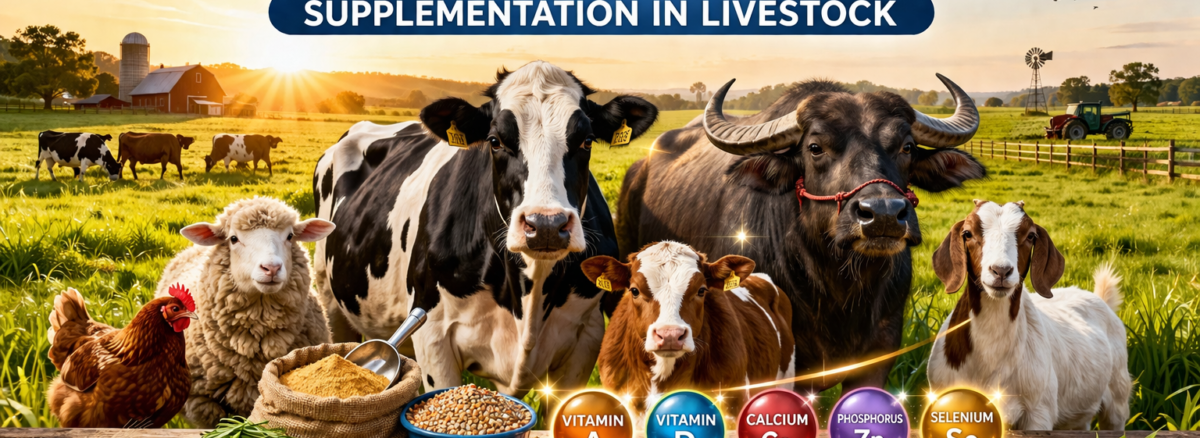
Vitamins and mineral supplementation is one of the most important but often neglected aspects of livestock farming. From a farmer’s point of view, we usually focus on feeding green grass, dry fodder, and concentrates, thinking that this is enough for the animal. However, even when animals are eating well, they may still suffer from hidden deficiencies of vitamins and minerals. These small nutrients play a big role in milk production, growth, fertility, and disease resistance. Without them, animals cannot perform to their full potential.
In practical field conditions, most of the feeds available to farmers—like paddy straw, wheat straw, or even green fodder—do not contain all the required vitamins and minerals in sufficient quantity. Soil in many areas is already deficient in important minerals, and this deficiency is transferred to crops and fodder. Similarly, vitamins can get destroyed during storage of feed or due to heat and sunlight. So, depending only on natural feeding is not enough, especially for high-yielding animals.
One of the first benefits farmers notice after starting vitamin and mineral supplementation is an increase in milk production. Lactating animals require a large amount of nutrients to produce milk. Minerals like calcium and phosphorus are directly used in milk formation, while vitamins like Vitamin A, D, and E support overall metabolism and udder health. If these nutrients are lacking, milk yield drops, and animals become weak. Problems like milk fever (due to calcium deficiency) and poor milk quality can occur. Regular supplementation helps maintain consistent milk yield and improves the quality of milk.
Another major advantage is improved reproductive performance. Many farmers face issues like animals not coming into heat, repeat breeding, low conception rates, or retained placenta after calving. In most cases, these problems are linked to deficiencies of minerals like phosphorus, zinc, and selenium, and vitamins like Vitamin A and E. When animals receive proper supplementation, heat cycles become regular, conception improves, and calving happens without complications. This means more calves and better farm productivity.
For calves and growing animals, vitamins and minerals are essential for proper growth and development. Calcium and phosphorus help in strong bone formation, while vitamins support immunity and overall body functions. If young animals do not receive these nutrients, they may show slow growth, weak bones, and delayed maturity. Farmers who supplement calves regularly notice faster weight gain, better health, and early readiness for breeding.
Vitamins and minerals also play a key role in disease resistance and immunity. Animals in field conditions are constantly exposed to infections, parasites, and environmental stress. Vitamins like Vitamin E and minerals like selenium act as antioxidants, protecting the body from damage and boosting immunity. Vitamin A helps maintain healthy skin and mucous membranes, which act as the first line of defense against infections. Zinc supports wound healing and skin health. Animals receiving proper supplementation fall sick less often and recover faster when they do.
Another important benefit is better feed utilization and digestion. In ruminants like cattle and buffaloes, minerals such as cobalt and sulfur are essential for proper functioning of rumen microbes. These microbes help
in digesting feed and converting it into useful nutrients. Vitamins, especially B-complex vitamins (produced in the rumen), also play a role in energy metabolism. When animals get adequate vitamins and minerals, they utilize feed more efficiently, resulting in better production with the same quantity of feed.
Farmers can also observe visible improvements in the appearance and activity of animals. Animals receiving proper supplementation have shiny coats, better skin condition, and are more active. Deficiency signs like rough hair coat, hair loss, dullness, or animals licking mud (pica) are reduced. These visible signs help farmers easily understand the benefits of supplementation.
In many villages, animals are mainly fed on crop residues, which are poor in both vitamins and minerals. This leads to multiple problems like low milk yield, poor fertility, weak calves, and frequent diseases. By adding a simple vitamin and mineral supplement to the daily ration, farmers can overcome these issues effectively.
Supplementation can be given in different forms such as powder (mineral mixture), liquid tonics, boluses, or lick blocks. Among these, mineral mixture powder and vitamin-mineral tonics are commonly used because they are easy to administer and cost-effective. Mixing the supplement with concentrate feed ensures that the animal consumes it regularly.
However, farmers should remember that giving too much of certain vitamins or minerals can also be harmful. Excess supplementation may lead to toxicity or imbalance in the body. Therefore, it is always better to use a balanced and scientifically formulated vitamin and mineral supplement rather than giving individual nutrients randomly. Consulting
a veterinarian helps in choosing the right product and dosage based on the animal’s age, production stage, and local feeding conditions.
From an economic point of view, vitamin and mineral supplementation is a low-cost, high-return investment. The daily cost per animal is very small, but the benefits in terms of increased milk production, improved fertility, faster growth, and reduced disease expenses are significant. Farmers who adopt this practice regularly see better overall performance and higher profits.
In conclusion, vitamins and minerals are small nutrients with a big impact on livestock productivity. Even if animals appear healthy, hidden deficiencies can reduce their performance. From a farmer’s perspective, regular supplementation is a simple and effective way to improve milk yield, reproduction, growth, and health. By making vitamin and mineral supplementation a routine practice, farmers can ensure healthier animals and a more profitable livestock business.